
Redundant/Duplicate Publications
Publication Process
The Davao Research Journal (DRJ) utilizes the Open Journal Systems (OJS), an open-source journal management and publishing platform developed by the Public Knowledge Project (PKP) under the GNU General Public License. All manuscript submissions are processed through the journal’s online submission system.
Upon submission, manuscripts undergo an initial editorial screening by one of the members of the Editorial Team. During this stage, the manuscript is evaluated for its relevance to the journal’s aims and scope, compliance with submission guidelines, overall quality, and adherence to publication ethics. Manuscripts may be rejected at this stage if they fail to meet the journal’s standards, contain evidence of plagiarism, research misconduct, ethical violations, or demonstrate insufficient scholarly quality.
Manuscripts that successfully pass the preliminary evaluation are forwarded for external peer review under a double-blind process, in which both the identities of the authors and reviewers remain confidential. The journal assigns at least two independent peer reviewers who possess expertise relevant to the manuscript’s subject area. To maintain impartiality and avoid conflicts of interest, reviewers suggested by the authors must not be affiliated with the same institution as the author(s).
Peer reviewers evaluate manuscripts based on scientific rigor, originality, methodological soundness, academic relevance, clarity of presentation, ethical compliance, and contribution to knowledge. Based on the reviewers’ recommendations, the Editor-in-Chief may issue one of the following decisions:
- Accept without revision
- Accept with minor revisions
- Major revisions required
- Reject
Authors are required to revise their manuscripts accordingly and submit a revised version together with a detailed response to the reviewers’ comments. Revised manuscripts may undergo further evaluation before a final editorial decision is made.
Once a manuscript is formally accepted, the authors receive an official acceptance notification. The article then proceeds to the production stage, which includes final proofreading, plagiarism verification, copyediting, formatting, layout design, metadata preparation, and online publication (see the infographics below). The final published article is subsequently archived and made openly accessible through the journal website.
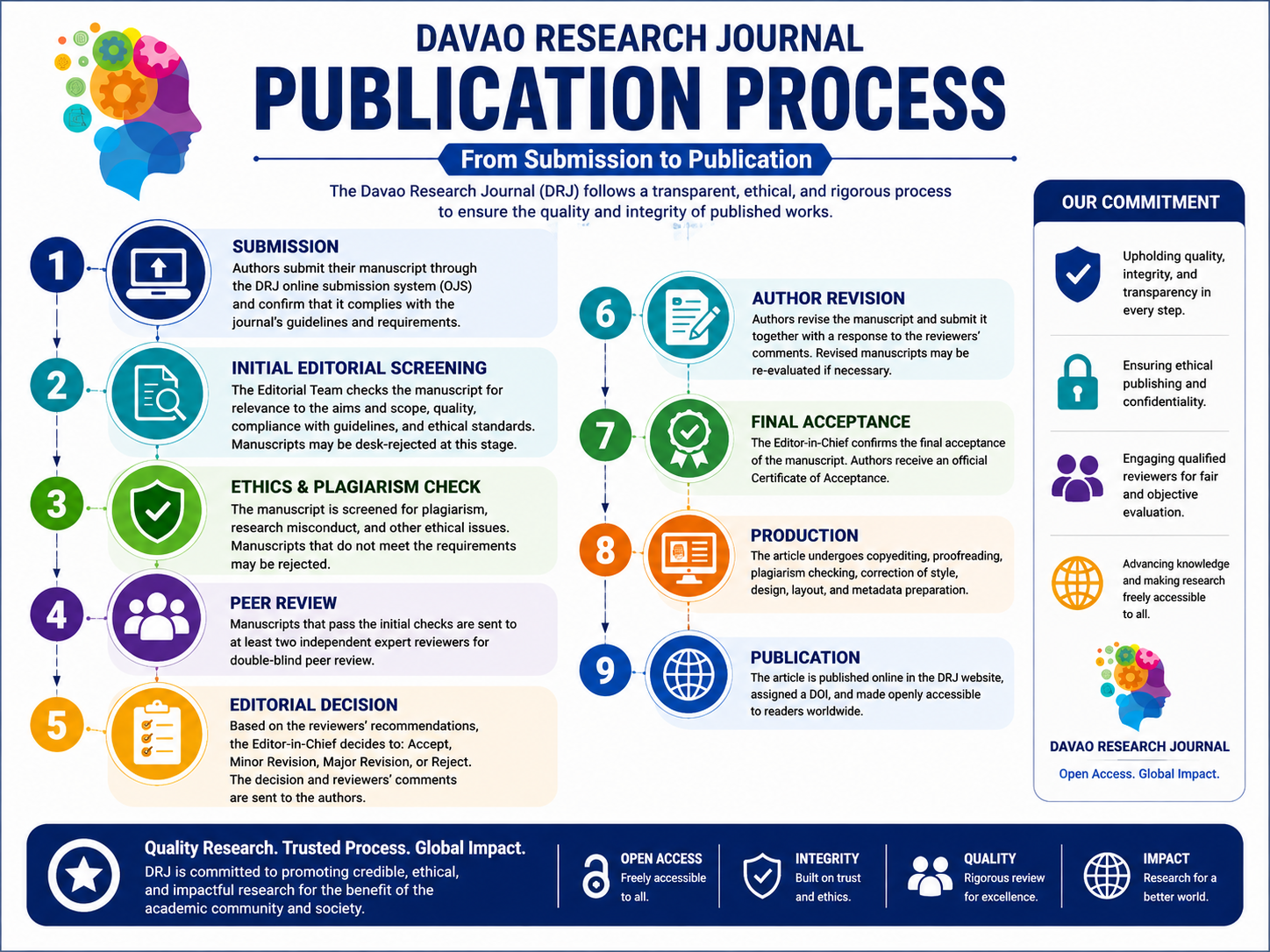
Figure 1. Publication process of the Davao Research Journal from submission to online publication.
Publication Notification
The Davao Research Journal (DRJ) notifies authors of editorial decisions, peer-review outcomes, manuscript revisions, acceptance, and publication status through the journal’s official communication channels (editor.drj@dorsu.edu.ph) and the OJS submission system. Authors are encouraged to provide active and accurate contact information during the submission process to ensure timely communication. Accepted manuscripts will be scheduled for publication based on the journal’s editorial workflow, publication frequency, and completion of all publication requirements. The Editorial Team reserves the right to make final decisions regarding publication scheduling and issue assignment in accordance with editorial and production considerations.
Publication Frequency
The Davao Research Journal (DRJ) was first published annually from 1998 to 2020, and in response to the increasing growth of scholarly submissions and expanding research engagement of the university and other neighboring higher institutions of learning that also supported the journal, it transitioned to a semi-annual publication schedule from 2021 to 2023, with issues released in June and December. Beginning in 2024, the journal adopted a quarterly publication frequency to accommodate the increasing volume of quality manuscript submissions and to enhance the timely dissemination of scholarly research. The journal now publishes four issues per year, released every March, June, September, and December. The journal is committed to maintaining a consistent and sustainable publication schedule in accordance with international scholarly publishing standards and best editorial practices.
Article Processing Charges (APC)
The Davao Research Journal (DRJ) provides immediate open access to all published articles to support the global exchange of knowledge. The journal is fully subsidized by the Davao Oriental State University (DOrSU), therefore authors are not required to pay any article processing charges (APCs), submission fees, or publication fees.