
LDPE Biodegradation Potential of Landfill-Derived Myrothecium sp. Strain Gavilo–Nemenzo (FS3) from Davao Oriental, Philippines
DOI:
https://doi.org/10.59120/drj.v17i2.587Keywords:
Biodegradation, Myrothecium sp., Low-density polyethylene (LDPE), plastic pollution, sanitary landfillAbstract
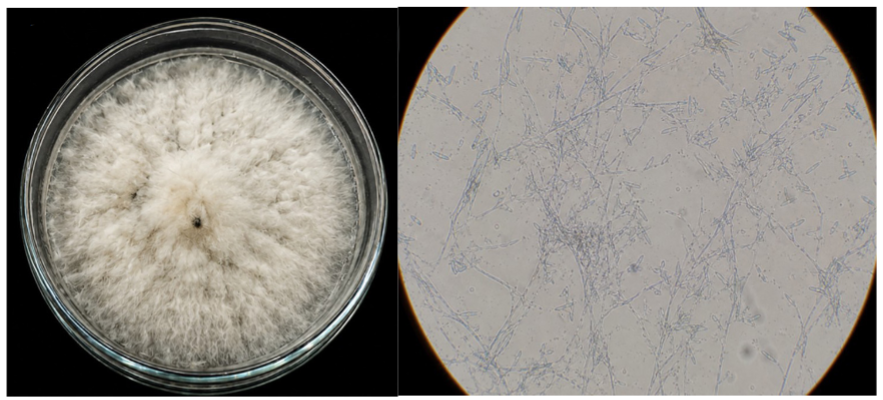
Plastic pollution remains a major environmental concern because of its persistence and resistance to natural degradation. This study aimed to isolate and characterize microorganisms associated with degraded LDPE plastic litter collected from the sanitary landfill in Davao Oriental, Philippines, and evaluate their potential for LDPE biodegradation. Microbial isolation from degraded LDPE samples yielded ten isolates, comprising five bacterial (BS1–BS5) and five fungal (FS1–FS5) strains. Morphological characterization was performed through observation of colony morphology and microscopic features of the recovered isolates. Screening assays identified fungal isolate FS3 as the most efficient LDPE degrader, causing surface roughening, thinning, deformation, fragmentation, and extensive fungal colonization of the plastic substrate. Stereomicroscopic and SEM analyses revealed dense fungal colonization and penetration of the LDPE surface, accompanied by extensive deterioration compared with uninoculated controls. Molecular characterization through Internal Transcribed Spacer (ITS) sequencing identified isolate FS3 as Myrothecium sp., exhibiting 100% sequence identity with Myrothecium sp. strain Wt303, and the isolate was consequently designated Myrothecium sp. strain Gavilo–Nemenzo (FS3). Future multilocus phylogenetic and morphological investigations will evaluate its taxonomic status and may support the proposal of the reserved species name Myrothecium gavilonemenzorum sp. nov. if warranted by the evidence. The isolate demonstrated LDPE biodegradation activity and polymer surface deterioration, highlighting its potential as a biological agent for plastic waste remediation. These findings demonstrate that sanitary landfill environments harbor microorganisms with plastic-degrading capabilities and support the potential application of Myrothecium sp. strain Gavilo-Nemenzo (FS3) in sustainable waste management, environmental biotechnology, and taxonomic investigations.
Downloads
References
Ali, S., Rehman, A., Hussain, S. Z., & Bukhari, D. A. (2023). Characterization of plastic degrading bacteria isolated from sewage wastewater. Saudi Journal of Biological Sciences, 30(5), 103628. https://doi.org/10.1016/j.sjbs.2023.103628
Ameen, F., Al-Homaidan, A. A., Al-Sabri, A. E., Al-Masaudi, S. B., & Al-Nadhari, S. (2025). Advances in fungal biodegradation of synthetic plastics: Mechanisms and molecular insights. Journal of Environmental Management, 360, 122879. https://doi.org/10.1016/j.jenvman.2024.122879
Amobonye, A., Bhagwat, P., Singh, S., & Pillai, S. (2020). Plastic biodegradation: Frontline microbes and their enzymes. Science of the Total Environment, 759, 143536. https://doi.org/10.1016/j.scitotenv.2020.143536
Downloads
Published
Issue
Section

License
Copyright (c) 2026 Eunice M. Gavilo, Phoebe Nemenzo-Calica

This work is licensed under a Creative Commons Attribution-NonCommercial 4.0 International License.
DRJ is an open-access journal and the article's license is CC-BY-NC. This license allows others to distribute, remix, tweak, and build on the author's work, as long as they give credit to the original work. Authors retain the copyright and grant the journal/publisher non-exclusive publishing rights with the work simultaneously licensed under a https://creativecommons.org/licenses/by-nc/4.0/.