
Microbial Water Quality and Contamination Drivers in Ecotourism Freshwaters of Mt. Hamiguitan Range Wildlife Sanctuary
DOI:
https://doi.org/10.59120/drj.v17i3.623Keywords:
Escherichia coli, Microbial water quality, Mt. Hamiguitan Range Wildlife Sanctuary, Petrifilm™, Total coliformsAbstract
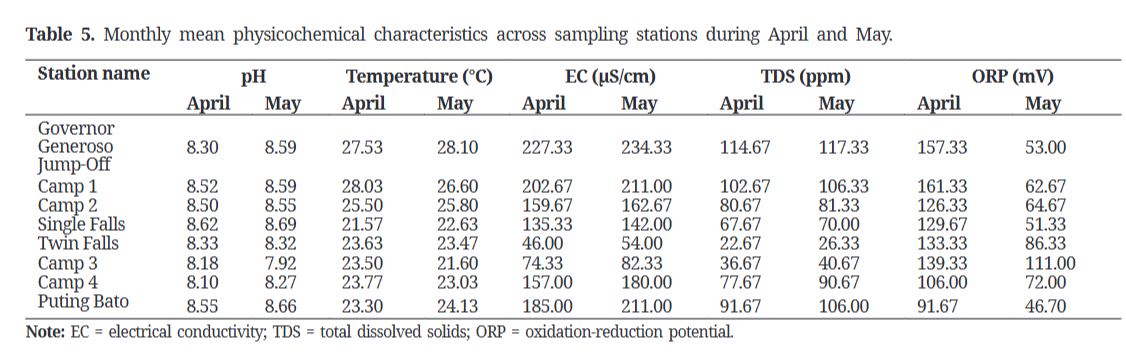
Freshwater ecosystems in protected ecotourism areas are increasingly threatened by microbial contamination linked to human activities, with implications for ecosystem integrity and public health. This study assessed microbial water quality along the San Isidro and Gov. Generoso ecotourism trails of Mt. Hamiguitan Range Wildlife Sanctuary, Philippines. It determined total coliform and Escherichia coli concentrations, characterized physicochemical and hydrological conditions, examined relationships with environmental parameters, and established baseline data using a field-based cross-sectional design. Water samples from eight stations collected in April–May 2026 were analyzed using Petrifilm™ E. coli/Coliform Count Plates, alongside in situ measurements and spatial, temporal, and correlation analyses. Total coliform concentrations ranged from 1.33–44.78 CFU/100 mL in April and 0.22–27.00 CFU/100 mL in May, remaining within DENR Class C standards. E. coli ranged from 0–1.33 CFU/100 mL in April and 0–4.89 CFU/100 mL in May, with the highest level recorded at Governor Generoso Jump-Off; Camp 3 was consistently elevated, while Camp 2 showed no detectable E. coli. Significant spatial variation was observed for total coliform (F = 16.92, p < 0.001) and E. coli (F = 8.47, p < .001). Microbial indicators were associated with physicochemical variables, particularly pH (rₛ up to −0.606), and site conditions reflecting human activity. Findings confirm uneven microbial contamination driven by anthropogenic and environmental factors. The baseline data highlight the need for routine monitoring, improved sanitation, and site-specific visitor management to reduce contamination risks and support adaptive, evidence-based ecotourism governance in Mt. Hamiguitan under increasing visitor pressure.
Downloads
References
Abello, J. J., Malajacan, G. T., Labrador, K. L., Nacario, M. A. G., Galarion, L. H., Obusan, M. C., and Rivera, W. L. (2021). Library-independent source tracking of fecal contamination in selected stations and tributaries of Laguna Lake, Philippines. Journal of Water and Health, 19(4). https://doi.org/10.2166/wh.2021.058
Abris, M. I., Palanca, M. G., De Leon, M. P., and Banaay, C. G. B. (2020). Microbial air and water quality assessment of a freshwater limestone cave in the Philippines and its implications for ecotourism management. Journal of Nature Studies, 19(1), 33–48.
American Public Health Association. (2023). Standard methods for the examination of water and wastewater (24th ed.). APHA Press. https://www.standardmethods.org
Downloads
Published
Issue
Section

License
Copyright (c) 2026 Meljay D. Castre, Phoebe Nemenzo-Calica

This work is licensed under a Creative Commons Attribution-NonCommercial 4.0 International License.
DRJ is an open-access journal and the article's license is CC-BY-NC. This license allows others to distribute, remix, tweak, and build on the author's work, as long as they give credit to the original work. Authors retain the copyright and grant the journal/publisher non-exclusive publishing rights with the work simultaneously licensed under a https://creativecommons.org/licenses/by-nc/4.0/.