
Antifungal Potential of Different Weed Leachates for the Postharvest Control of Papaya Anthracnose Caused by Colletotrichum spp.
DOI:
https://doi.org/10.59120/drj.v17i3.603Keywords:
Antifungal activity, botanicals, fruit shelf-life, leachates, poison food techniqueAbstract
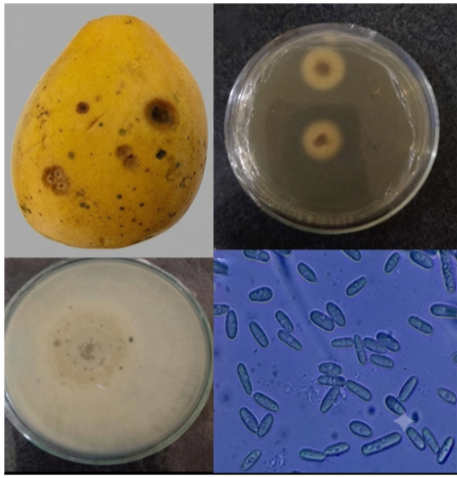
A wide variety of fungal pathogens cause postharvest diseases in papaya. Among these, anthracnose caused by Colletotrichum spp. is considered one of the most destructive diseases, resulting in significant postharvest losses worldwide. Several plant extracts and leachates have been reported to possess antifungal activity against various fungal pathogens. This study evaluated the efficacy of Solanum torvum, Amaranthus viridis, and Lantana camara leachates in controlling anthracnose in ‘Solo’ papaya. Both in vitro and in vivo experiments were arranged using a Completely Randomized Design (CRD). The in vitro test consisted of 11 treatments with 132 samples, while the in vivo test included six treatments with 54 samples. Results showed that all leachates at 5% concentration inhibited the mycelial growth of Colletotrichum spp. under in vitro conditions. In vivo, A. viridis recorded the lowest disease severity (47.08%), followed by S. torvum (65.37%) and L. camara (73.06%). Significant differences among treatments were observed for disease severity, visual quality, and degree of shriveling at 3, 5, and 7 days after treatment (p < 0.05). The findings suggest that A. viridis leachate has promising potential as a natural alternative for the postharvest management of papaya anthracnose by reducing disease development and maintaining postharvest fruit quality. Further studies are recommended to identify the active antifungal compounds, determine their mode of action, and evaluate the effectiveness of the leachates using larger sample sizes under semi-commercial and commercial postharvest storage conditions.
Downloads
References
Afroz M., Akter S., Ahmed A., Rouf R., Shilpi J.A., Tiralongo E., Sarker S.D., Göransson U. and Uddin S.J. (2020). Ethnobotany and Antimicrobial Peptides from Plants of the Solanaceae Family: An Update and Future Prospects. Front. Pharmacol. 11:565. doi: 10.3389/fphar.2020.00565
Amarakoon, R. D.C.K. Illeperuma and Sarananda, K.H. (1999). Effect of calcium carbide treatment on ripening and quality of vellaicolomban and Willard mangoes. Tropical Agricultural Research 11: 54-60.
Balachandran, C., Duraipandiyan, V., Al-Dhabi, N. A., Balakrishna, K., Kalia, N. P., Rajput, V. S., Khan, I. A., and Ignacimuthu, S. (2012). Antimicrobial and Antimycobacterial Activities of Methyl Caffeate Isolated from Solanum torvum Swartz. Fruit. Indian Journal of Microbiology, 52(4), 676–681. https://doi.org/10.1007/s12088-012-0313-8
Downloads
Published
Issue
Section

License
Copyright (c) 2026 Ana Jesa M. Ocho, Jeric C. Biol, Roel Z. Rementizo, Merlina H. Juruena, Sheryl S. Bayang

This work is licensed under a Creative Commons Attribution-NonCommercial 4.0 International License.
DRJ is an open-access journal and the article's license is CC-BY-NC. This license allows others to distribute, remix, tweak, and build on the author's work, as long as they give credit to the original work. Authors retain the copyright and grant the journal/publisher non-exclusive publishing rights with the work simultaneously licensed under a https://creativecommons.org/licenses/by-nc/4.0/.