
Green Extraction and Sustainability Assessment of Total Carotenoids from Carrot (Daucus Carota) Peel Waste using Soybean Oil
DOI:
https://doi.org/10.59120/drj.v17i2.575Keywords:
Carotenoids, carrot peels, full factorial, soybean oil, green extractionAbstract
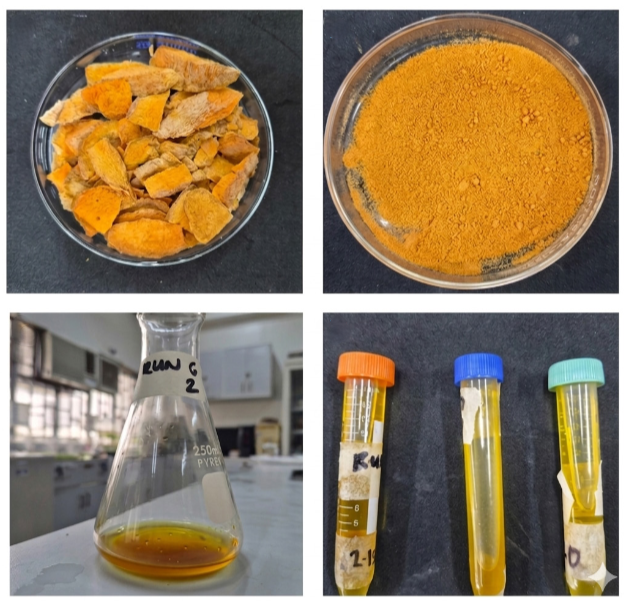
The environmental and health impacts of organic solvent extraction for carotenoid recovery highlight the need for a greener, more sustainable process. This study investigates the use of soybean oil as a green, environmentally friendly alternative for recovering carotenoids from carrot (Daucus carota) peels, offering a zero-waste approach to conventional, often toxic organic solvents. A two-factor, three-level full factorial experimental design was employed to evaluate and optimize the temperature (30, 45, and 60 °C) and the liquid-solid (L/S) ratio (20, 30, and 40 mL:g). In addition, Total Carotenoid Content (TCC) was quantified with UV-Visible spectrophotometry. Statistical analyses showed that the L/S ratio primarily drove extraction efficiency (p < 0.01), thereby improving mass transfer and matrix penetration. Temperature (p < 0.01) and its interactions with the L/S ratio (p < 0.01) also significantly enhanced cell wall permeability. The model was reduced, as quadratic terms were insignificant (p > 0.05). The optimal predicted conditions of the reduced model yielded 77.49 ± 13.13µg β-carotene/g of dried peel at a 40 L/S ratio and 30 °C, with validation runs yielding 76.04 ± 3.71 13µg β-carotene/g of dried peel. A final score of 0.59 based on the Path2Green sustainability metrics suggests that the carotenoid extraction process is eco-friendly and low-impact, especially high (+1.00) in biomass utilization, post-treatment, scaling, transport, waste, purification, application, and the use of eco-friendly solvents. These findings demonstrate that soybean oil is an effective and sustainable solvent alternative for carotenoid recovery, offering a practical option for greener industrial processes.
Downloads
References
Antolin, M. C. R., & Malanon, H. G. (2024). Value chain mapping of carrots: The case of Negros Oriental, Philippines. International Journal of Multidisciplinary Research and Publications, 7(2), 120–125.
Badea, G. I., Gatea, F., Litescu-Filipescu, S. C., Alecu, A., Chira, A., Damian, C. M., & Radu, G. L. (2025). Optimization of Green Ultrasound-Assisted Extraction of Carotenoids and Tocopherol from Tomato Waste Using NADESs. Molecules, 30(3), 591. https://doi.org/10.3390/molecules30030591
Butt, N. A., Shaikh, F., & Sohail, S. M. (2026). Nutritional aspects of carrot by-products. In H. Bader Ul Ain, T. Tufail, F. Saeed, & H. Ansar Rasul Suleria (Eds.), Importance of plant based byproducts: Nutritional and functional properties (pp. 139–157). Springer Nature Switzerland. https://doi.org/10.1007/978-3-032-03503-5_6
Downloads
Published
Issue
Section

License
Copyright (c) 2026 Hans Cedric F. Palero, Heleina Melissa I. Bobadilla, Paolo Santino B. Ramiso, Cynthia F. Madrazo, John Ray C. Estrellado

This work is licensed under a Creative Commons Attribution-NonCommercial 4.0 International License.
DRJ is an open-access journal and the article's license is CC-BY-NC. This license allows others to distribute, remix, tweak, and build on the author's work, as long as they give credit to the original work. Authors retain the copyright and grant the journal/publisher non-exclusive publishing rights with the work simultaneously licensed under a https://creativecommons.org/licenses/by-nc/4.0/.